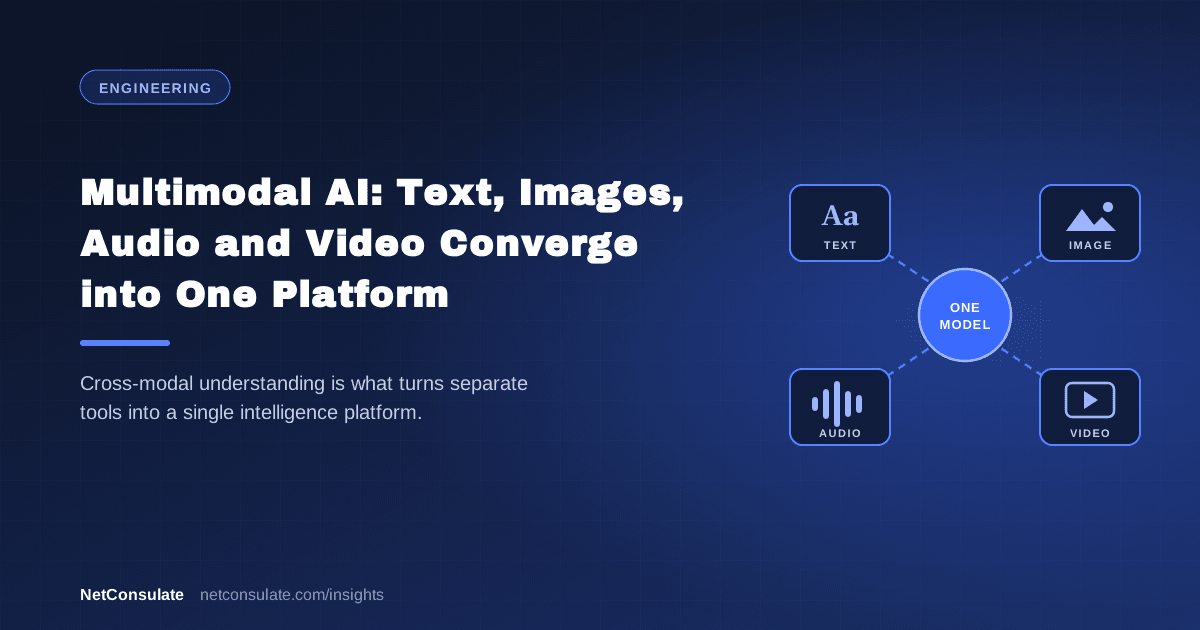
Multimodal AI: How Text, Images, Audio and Video Are Converging into One Intelligence Platform
For years, enterprise AI meant a collection of separate tools. One model transcribed the meeting. Another read the slide deck. A third summarised the notes. A fourth searched the document archive. Each did its own job reasonably well, and the people in the middle did the real work of connecting the outputs: noticing that the decision in the recording contradicted the number on the slide.
Multimodal AI is the attempt to close that gap. Instead of treating text, images, audio and video as separate formats handled by separate systems, it aims to build systems that understand the relationships between them. A single request can combine a recorded process, a spoken instruction and a maintenance log, and the answer can come back as text, speech or an image.
This article explains what multimodal AI is, how a typical pipeline works, the technologies driving convergence, what recent releases suggest about direction, where it applies, and, most importantly for anyone building with it, the engineering and governance problems that decide whether it works in production. It builds on the retrieval and edge architecture covered in our multimodal AI, vector database and on-device AI guides. Written for CTOs, product owners and engineers evaluating multimodal systems for real workloads.
What Multimodal AI Is, and Why Convergence Matters
A modality is a form of information: text, images, audio or video. Traditional AI tends to specialise in one. Speech recognition turns audio into text. Computer vision identifies objects in images. Multimodal AI processes and, depending on the model, generates more than one modality, and connects them.
Consider uploading a video of a manufacturing line and asking: "Identify the machine failure, explain what happened before it, and suggest corrective actions." A multimodal system can analyse the frames, read visible indicators, interpret spoken instructions, locate the relevant timestamps and write an explanation. Separate tools would each handle one piece and leave the integration to a person.
The value of multimodal AI is not that it handles more file types. It is that it connects what each one says.
That ability, cross-modal understanding, is the difference between a bundle of tools and a platform.
How a Multimodal Pipeline Works
Implementations differ, but most follow five stages.
| Stage | What happens |
| Ingestion | Text, images, audio and video arrive, independently or together |
| Encoding | Each modality is turned into a representation a neural network can process: tokens for text, patches for images, acoustic features for audio, frame sequences for video |
| Cross-modal alignment | The system learns that an image of a dog running and the caption "a dog running in a park" describe the same thing, and likewise for speech and text, or frames and sounds |
| Unified reasoning | Aligned representations are combined to answer questions, summarise, or decide |
| Generation | Output is produced in the needed format: text, speech, images, video or structured data |
The Technologies Behind Convergence
Vision-language models (VLMs). These let a system answer questions about what it sees: read a chart in a dashboard screenshot, find the highest-revenue segment, flag unusual patterns. They underpin document intelligence, visual search and enterprise knowledge management. Audio-language models. Modern audio models do more than transcribe. Depending on the model, they can follow spoken instructions, separate speakers, translate speech, respond in natural voice and take part in real-time conversation. Audio is treated as a rich source of information, not text waiting to be transcribed. Video understanding. Video adds time. A model has to understand not just what is in a frame but how people, objects and events change, which matters for industrial monitoring, robotics, sports analytics and content processing. Shared embedding spaces. An embedding is a numerical representation that captures meaning. When different modalities map into one shared space, a text description, a photo and a video of the same place land near each other. That enables cross-modal retrieval: search a media library by describing what you want, with no filename. For enterprise search and retrieval-augmented generation, this is one of the most practically important developments, and it extends the vector database patterns described in our earlier guide. Unified architectures. Transformers have spread from language into vision, audio and generation, and the direction is toward fewer boundaries between modalities. Today's production systems, though, often combine specialised encoders, language models, generators and an orchestration layer rather than one network for everything.What Recent Releases Suggest
Several 2026 releases, as reported by their publishers and press coverage, illustrate the shift from demos toward usable platforms. We have summarised them from the source material provided, so check each vendor's own documentation before relying on specifics.
- Gemini 4 Argon (Google, announced September 2026): presented as a model family converging language, vision, audio and video with advanced reasoning.
- Genie 4 (Google DeepMind, October 2026): combines visual world generation with synchronised audio and interactive simulation, pointing to multimodal AI moving from content toward environments that respond to user actions.
- EmbeddingGemma 2 (Google, October 2026): reported as a compact model, around 740 million parameters, that maps text, images, video and audio into a shared embedding space, relevant to multimodal retrieval and on-device use.
- Patram 1.5 (November 2026): reported as an open-weight vision-language model for document intelligence, aimed at scanned documents, tables, forms and charts.
Where It Applies
- Healthcare: combining medical images, clinical notes and lab reports to support documentation and information retrieval. Clinical decisions still need medical validation, as covered in our healthcare AI article.
- Enterprise intelligence: analysing documents, presentations, recorded meetings and dashboards together for knowledge discovery, reporting and decision support.
- Manufacturing: joining camera feeds, sensor data, maintenance records and operator instructions for visual inspection, predictive maintenance and anomaly detection.
- Education: interactive learning that mixes written explanation, diagrams, speech and video, with support for multilingual and accessible content.
- Automotive and autonomous systems: combining camera, sensor, audio and navigation inputs into one view of the environment.
- Media: generating and editing video, audio, images and subtitles from natural-language instructions.
Single-Modal vs. Multimodal: What Actually Changes
| Capability | Single-modal approach | Multimodal approach |
| Image, audio, video understanding | Separate model for each | Integrated or connected |
| Cross-modal reasoning | Limited, done by people | Core capability |
| Unified interaction | Limited | Supported |
| Content generation | Modality-specific | Multiple modalities, depending on the model |
The Engineering Challenges That Decide Success
Compute and cost. Video, high-resolution images and long audio are expensive to process. Video is the heaviest because of frame count and temporal relationships. Inference pipelines, memory use and cost per request need deliberate design. Cross-modal accuracy. A model can correctly identify a machine in a video yet match the wrong sound to a mechanical event. Evaluate cross-modal reasoning specifically, not just each modality on its own. Data alignment and quality. Wrong captions, poor transcripts, mismatched frames and inconsistent metadata degrade results. Quality of paired data matters as much as quantity. Privacy and security. Multimodal systems handle photographs, voice recordings, video, business documents, medical records and biometric information. They need encryption, access controls, retention policies, consent mechanisms and data governance. Local processing, as described in our hybrid inference article, can reduce what leaves the device. Hallucination and reliability. Models can misread a chart, mishear a statement or invent details about an image. In healthcare, finance and industrial safety, independent validation and human oversight remain essential, and the observability practices in our AI observability guide apply to multimodal systems too. Enterprise integration. Real value depends on secure APIs, data pipelines, retrieval systems and well-defined permissions connecting the model to existing databases, document platforms and communication tools.The hard part is not building a powerful model. It is building a reliable platform around it.
What to Watch Next
- Real-time multimodal interaction: live speech, vision and context combined for more natural assistants.
- Unified AI workspaces: documents, recordings, dashboards and video handled through one interface.
- Multimodal agents: agents that observe visual environments, understand spoken instructions, read documents and act through tools, which raises the identity and governance questions in our agent identity article.
- On-device multimodal intelligence: smaller models and compact embeddings making local processing practical.
- Interactive generated worlds: simulations that combine scenes, audio and behaviour for training and robotics.
- Physical AI: robots using camera, voice, sensor and environmental inputs together.
What to Actually Do With This Right Now
Start with a cross-modal workflow that people already do by hand. Meeting-to-action-item summaries, document and chart extraction, and visual inspection with maintenance records are good first targets, because the value is easy to measure. Pick a unified embedding or retrieval layer before a unified generator. Searching across text, images, audio and video usually pays back first, and it improves every later feature. Test cross-modal reasoning on your own data. Public benchmarks will not tell you whether the model links the right sound to the right event in your environment. Decide where data is allowed to go. Classify what is sensitive, and keep it local or redacted where you can. Keep a human in the loop for high-impact outputs. Treat multimodal answers as drafts to verify wherever errors are costly.A Readiness Checklist
- Candidate workflows identified where staff currently combine text, images, audio or video by hand
- Required input and output modalities defined per workflow, with success metrics
- Model options tested on your own documents, recordings and images, including cross-modal questions
- Retrieval or embedding strategy chosen for multimodal search and RAG
- Cost and latency measured for video, high-resolution image and long-audio workloads
- Data classified by sensitivity, with consent, retention and access controls defined
- Local or redacted processing considered for sensitive inputs
- Human review defined for healthcare, finance, safety and other high-impact outputs
- Monitoring in place for accuracy, hallucination rate, cost and drift across modalities
- Integration plan covering APIs, permissions and existing enterprise systems
Conclusion
Multimodal AI is moving the field from isolated capabilities toward systems that perceive and reason across text, images, audio and video together. The real prize is not processing more kinds of data. It is understanding how different sources relate, and using that to solve problems that used to need a person to stitch several tools together. The teams that benefit will be the ones that pair the models with strong retrieval, careful evaluation of cross-modal accuracy, clear data governance and human oversight where it counts. The future of AI is not only conversational. It is multimodal, contextual and increasingly integrated, but it only pays off when it is built as a reliable platform.
If your organisation is planning multimodal AI, from document and video intelligence to multimodal search, NetConsulate designs and builds these systems with retrieval, privacy and evaluation designed in from the start.
Planning a multimodal AI solution and want it built as a reliable platform? Submit a proposal request and our team will respond with a tailored approach within 2 business days.