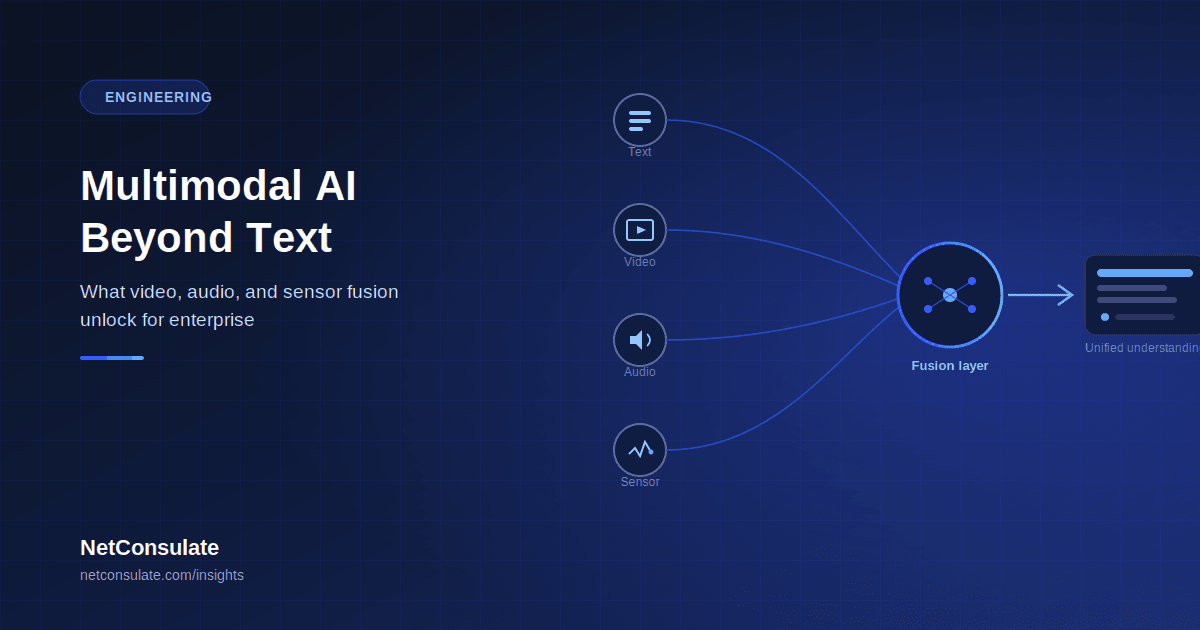
Multimodal AI Beyond Text: What Video, Audio, and Sensor Fusion Unlock for Enterprise
Most enterprise AI conversations still default to text — a chatbot, a document summariser, an email drafter. But a growing share of the information that actually matters to a business never arrives as clean text at all: it's a customer's tone of voice on a support call, a factory floor camera feed, a thermal sensor reading, a screen-share showing an error a customer can't quite describe in words. Multimodal AI — systems that process and reason across several of these data types simultaneously rather than one at a time — is how enterprises are starting to put AI against that much larger share of their actual operational data.
This article explains what multimodal AI actually is, how the fusion process works, where it's already delivering measurable enterprise value, and what building a multimodal system honestly requires. It connects directly to work we've covered elsewhere on this site — computer vision defect detection, AppFunctions, and autonomous agents are all, in different ways, applications of multimodal reasoning. Written for technical decision-makers evaluating where multimodal AI fits their own data.
What Multimodal AI Actually Is
Multimodal AI is a system that integrates and processes several types of data — text, images, video, audio, sensor data — simultaneously, rather than a single model handling one modality while other data sources sit unused. The defining shift from earlier AI systems is that the model isn't reading one modality and ignoring the rest; it's reasoning across them together, using each one to resolve ambiguity the others can't.
That last point is the actual value proposition, not a technical footnote: one modality can resolve the ambiguity of another. A support ticket that says "it's making a weird noise" is nearly useless alone; paired with an audio clip of the noise and a photo of the device, a multimodal system can reason about all three together and arrive at a far more accurate diagnosis than any single input could support. This is also why multimodal systems tend to be more resilient to noisy or incomplete data — when one channel is ambiguous or degraded, the others provide corroborating context a single-modality system simply doesn't have access to.
How the Fusion Process Actually Works
A multimodal system has three architectural stages, and understanding them matters for anyone evaluating build-versus-buy decisions in this space:
Modality encoders convert each input type into the model's internal representation — a vision encoder for images, an NLP encoder for text, an audio encoder for speech, and so on — each initially trained on its own single-modality task before being connected to the rest of the system, which tends to be more stable than training everything jointly from scratch. The fusion layer is where the real value and the real difficulty concentrate. Modern architectures use cross-attention mechanisms that let the system actively seek connections across modalities — for instance, linking a specific phrase in a transcript to the exact video frame it refers to — rather than simply processing each input separately and concatenating the results afterward. This is the stage that turns "several AI models running side by side" into genuine multimodal reasoning, and it's also where most of the engineering difficulty in building these systems actually lives. The output decoder produces results in whatever format the task requires — a text description of visual content, a structured data extraction from a mixed-media document, an audio response that incorporates visual context, or a risk score derived from combined sensor and video input.Where This Is Already Delivering Enterprise Value
Adoption is no longer experimental at the enterprise level: roughly 65% of large enterprises are now actively testing or deploying multimodal AI in production environments according to recent industry survey data — this has moved well past early pilot territory for large organisations specifically.
Customer support that sees what the customer sees. Combining text, screen-share, and voice lets a support system understand a customer's problem the way a skilled human agent would — reading the error message, seeing the exact screen state, and hearing the frustration in their voice — rather than working from a text description alone that often can't fully capture what's actually going wrong. Document intelligence across mixed formats. Real business documents are rarely clean text — forms, tables, diagrams, and handwritten annotations coexist on the same page. Multimodal document intelligence processes all of these together, extracting structured data from documents that would defeat a text-only extraction pipeline entirely. Manufacturing audio and vision monitoring together. Beyond the vision-only defect detection covered in our computer vision guide, audio monitoring adds a genuinely complementary signal — enterprise applications increasingly pair manufacturing audio monitoring with vision data, enabling natural language search across both, meaning a maintenance engineer can query "find instances of that grinding noise near the conveyor last week" and retrieve matching audio-visual moments directly, rather than manually reviewing hours of footage. Healthcare imaging combined with clinical records. Integrating diagnostic imaging with pathologist notes and patient history — rather than analysing images in isolation — supports more accurate diagnostic support, connecting directly to the clinical decision support architecture covered in our healthcare AI guide, extended here with a second modality feeding the same clinical reasoning. Emotion and sentiment signals combining voice and expression. Combining facial expression analysis with voice pitch and tone provides a materially richer signal for mood and sentiment than either channel alone — relevant for customer experience monitoring, though this application carries real privacy and consent considerations that deserve the same governance discipline covered in our AI governance guide, not lighter treatment because the underlying signal is emotional rather than transactional. Accessibility through cross-modal redundancy. Lip-reading combined with audio speech recognition improves accuracy for users with hearing impairments or in noisy environments — the same principle of complementary modalities resolving ambiguity, applied directly to the accessibility use cases covered in our special education guide. Autonomous systems fusing vision and sensor data. Robotics and autonomous vehicles fundamentally depend on fusing vision, depth, and other sensor streams — the same underlying discipline covered in our world models and physical AI article, where a world model reasoning across camera, force, and depth data is itself a multimodal system applied to physical action.The Model and Embedding Landscape
Two distinct technical approaches matter for enterprise builders:
Frontier multimodal models (GPT-4o and successors, Gemini's video-capable generations, Claude's vision-enabled models, Llama 3.2) natively handle multiple modalities within a single model, rather than chaining together separate specialised systems — the practical enterprise entry point for most applications, accessed via API without needing to train anything from scratch. Multimodal embedding models solve a different, often more enterprise-relevant problem: making different data types searchable together. Meta's ImageBind aligns six modalities — images, text, audio, video, depth, and thermal data — in a single shared embedding space, enabling cross-modal retrieval: matching a thermal camera image against a visible-light photo, or linking a depth sensor reading to a natural-language description. CLAP does the equivalent for audio and text specifically, enabling natural-language search over audio archives — call centre recordings, manufacturing floor audio, media libraries — without manually transcribing and tagging every file first. The trade-off worth knowing: these broadly-aligned embedding models generally sacrifice some per-modality quality compared to specialists built for a single modality pair, such as CLIP for image-text specifically — a genuine choice between breadth and precision that should be made deliberately, not by default.What Building This Honestly Requires
Computational cost is genuinely higher, not marginally higher. Processing and training across multiple data types simultaneously demands significantly more compute than a single-modality system — this should be budgeted realistically from the start rather than discovered mid-project. Data alignment is the actual bottleneck, more often than the modelling. Misalignment between audio and video, or between an image and its corresponding text description, produces a straightforward garbage-in, garbage-out result no amount of downstream fusion sophistication can fix. Temporal alignment (matching the right audio moment to the right video frame) and spatial alignment (matching a label to the right region of an image) are both genuinely expensive to annotate correctly, and underinvesting here is the most common cause of disappointing multimodal system performance. Missing modalities need an explicit plan, not an assumption of always-on inputs. A camera failing in an autonomous vehicle, a microphone dropping out mid-call — real deployments must handle a modality going missing gracefully rather than failing outright, and this needs to be designed for deliberately, particularly in any safety-relevant application. Unified data infrastructure is a prerequisite, not a nice-to-have. Establishing an architecture that can collect, clean, and synchronise data from genuinely different sources — audio recordings, sensor telemetry, video streams, structured records — is a substantial undertaking in its own right, and it needs to exist before any meaningful fusion modelling can begin. Storage and lifecycle cost adds up quickly and needs deliberate management. Multimodal applications typically need to retain raw media files, processed intermediate versions, and derived embeddings simultaneously — a materially larger storage footprint than a text-only system, and one that benefits from explicit retention and tiering policy rather than indefinite retention by default.A Practical Path Forward
Start with a single high-value modality pairing, not a full multimodal platform. The strongest early wins typically come from combining exactly two complementary modalities against one well-scoped problem — audio plus video for manufacturing monitoring, text plus image for document intelligence, voice plus screen-share for support — rather than attempting to fuse every available data type simultaneously from day one. Choose frontier APIs over custom training for most first applications. Given the computational cost of training multimodal systems from scratch, using an existing multimodal model via API is the pragmatic starting point for the great majority of enterprise use cases — reserve custom training and fusion architecture for cases where off-the-shelf models genuinely fall short on your specific data. Invest in alignment quality before fusion sophistication. Given how consistently misalignment causes disappointing results, time spent ensuring your audio, video, text, and sensor data are correctly and precisely aligned pays back more reliably than time spent on more advanced fusion architecture applied to poorly aligned data. Bring in specialised expertise once the project moves past a proof of concept. Multimodal systems are deceptively tricky to get right in production — the point at which doing it entirely in-house stops making sense is typically when dataset alignment becomes the bottleneck, or when the system needs to gracefully handle missing or degraded modalities in a way a prototype never had to.A Readiness Checklist
- A specific, well-scoped problem identified where two or more data modalities are genuinely complementary
- Data alignment quality assessed honestly for the modalities involved (temporal, spatial, or both)
- A decision made between frontier multimodal API and multimodal embedding models based on whether the need is generation/reasoning or cross-modal search
- Missing-modality handling designed explicitly, not assumed away
- Compute and storage costs budgeted against multimodal-specific requirements, not extrapolated from a text-only system
- Privacy and governance review completed for any modality involving biometric, emotional, or personally identifying signals
Conclusion
Multimodal AI is how enterprises finally put AI against the majority of their operational data that was never text in the first place — the tone of a support call, the footage from a factory floor, the sensor reading from a piece of equipment, the screen a frustrated customer is looking at. The technology has moved from research curiosity to production infrastructure at real scale, but the honest engineering challenges — data alignment, computational cost, and graceful handling of missing modalities — are exactly where most projects succeed or stall, more often than in the sophistication of the fusion model itself.
If your organisation has valuable data locked in video, audio, or sensor streams that your current AI systems can't reason about, NetConsulate builds multimodal AI systems end to end — from modality alignment and fusion architecture to the governance discipline that responsible multimodal deployment requires.
Have data in video, audio, or sensor form that your AI systems aren't using? Submit a proposal request and our team will respond with a tailored approach within 2 business days.