Edge AI Everywhere: How On-Device Intelligence Is Expanding Beyond Mobile
For years, "edge AI" meant one thing in practice: a feature running on a smartphone, usually a camera effect or a voice command, always slightly overshadowed by whatever the cloud version of the same model could do better. That framing is now badly out of date. In 2026, edge AI is production infrastructure running inside industrial robots, hospital wearables, traffic cameras, building management systems, and vehicles — not because on-device models finally caught up to cloud models, but because a specific, well-defined set of problems were never going to be solved by the cloud in the first place, no matter how capable cloud models became.
This article explains what's actually driving edge AI's expansion in 2026, the hardware and business shifts making it viable at scale, where it's already deployed outside mobile, and what building for the edge honestly requires. It connects directly to the on-device patterns covered in our Gemini Nano 4 and small language models articles — this is that same efficiency logic applied to the much larger world of industrial and embedded devices. Written for technical decision-makers evaluating edge deployment for the first time.
Why Edge, Not Cloud — The Argument That Doesn't Depend on Model Quality
The case for edge AI was never really about model capability catching up. It's about four constraints that cloud inference cannot solve regardless of how good the model gets:
Latency that physics won't allow. A voice interface for hands-free industrial equipment control needs sub-200ms response times that cloud speech-to-text simply cannot guarantee over cellular or Wi-Fi in a noisy RF environment — the round trip itself is the bottleneck, not the model. The same applies to autonomous vehicle decision-making, where every millisecond of network round-trip is a millisecond a braking decision doesn't have. Connectivity that isn't guaranteed. Manufacturing floors, remote infrastructure, moving vehicles, and rural healthcare settings routinely operate with unreliable or absent connectivity. A system that stops working the moment a network drops isn't a viable safety or operations tool, however good its cloud-connected performance is when the network happens to be up. Privacy that cloud transmission structurally cannot offer. A wearable medical device detecting a cardiac anomaly locally, or an in-vehicle vision system processing road data without ever transmitting it, keeps sensitive data on the device by architecture, not by policy promise — a materially stronger position than any data-handling agreement covering cloud transmission. Bandwidth and cost that don't scale. Streaming continuous video or sensor data from thousands of deployed devices to the cloud for analysis is expensive at scale in a way that becomes the dominant cost driver of a large IoT deployment — inference at the source, sending only results rather than raw streams, changes that economics fundamentally.What's Making This Viable at Scale Now — Not Five Years From Now
Three concrete shifts in 2026 explain why edge AI moved from pilot to mass-market deployment this year specifically, not as a vague future trend:
Silicon finally does the job affordably. Modern edge hardware delivers tens to hundreds of TOPS (tera-operations per second) of AI compute within the power and thermal budgets of genuinely embedded devices — a capability jump that simply didn't exist in prior hardware generations at this price point. NVIDIA's Jetson Thor brought data-centre-class AI compute to physical machines; Qualcomm's Snapdragon X2 Elite Extreme turned laptops into genuine on-device AI workstations; AMD's Ryzen AI Embedded P100 extended NPU-equipped compute specifically into industrial edge deployment. This is not incremental improvement — it's a different category of what's affordable to embed. The economics of chip manufacturing are responding to real demand, not speculation. Texas Instruments' acquisition of Silicon Labs — whose Series 3 IoT platform delivers a tenfold processing improvement over its predecessor, purpose-built for intelligent edge devices — followed by TI's stated intent to manufacture at scale on its own 300mm wafers to cut per-unit cost, is the kind of move a company makes in response to demand it can already see, not a long-term speculative bet. When silicon manufacturers restructure supply chains around edge AI specifically, that's a stronger signal than any market forecast. Open-weight models removed the licensing bottleneck. The proliferation of high-quality open models — Qwen, Mistral, Llama, Gemma — means edge hardware deployment no longer requires proprietary model agreements or per-inference licensing costs. A developer with a Jetson Thor, an Apple Silicon Mac, or a Snapdragon-based device can run genuinely competitive, frontier-class AI locally with zero ongoing API cost — the same efficiency argument covered in our small language models article, now extended to embedded and industrial hardware specifically. The business model is shifting under manufacturers' feet. A sensor that transmits raw data is a hardware commodity, sold once at a thin margin. A device that detects anomalies, flags maintenance needs, or makes operational decisions locally is a fundamentally different product category — one that supports recurring, subscription-based pricing because it delivers ongoing intelligence, not a one-time data feed. This single dynamic is restructuring how OEMs across manufacturing, healthcare, and building-automation sectors think about their product lines, and it's a major reason edge AI investment accelerated so sharply this year specifically.Where Edge AI Is Already Running — Well Beyond Mobile
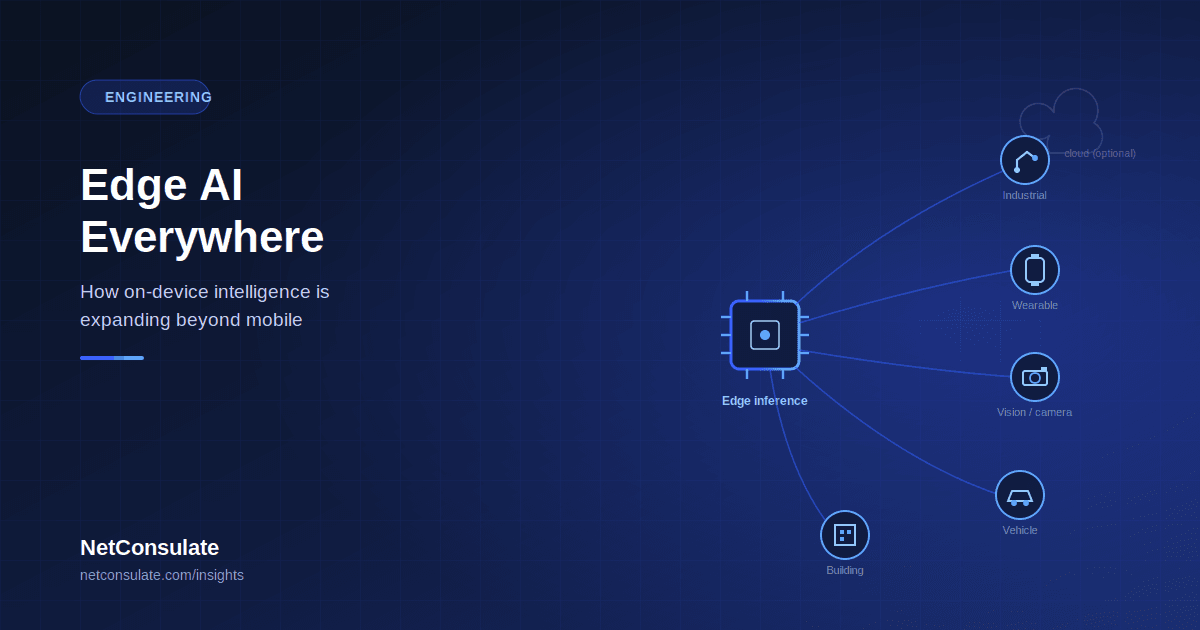
Industrial quality control and predictive maintenance. Vision models running directly on production-line cameras spot defects instantly and can stop a conveyor before a faulty item proceeds — the same defect-detection discipline covered in our computer vision guide, deployed at the edge specifically because the latency of a cloud round-trip would let the faulty part pass before a cloud-based verdict returned. Machines increasingly monitor their own health with on-device intelligence, connecting directly to the predictive maintenance architecture covered in our manufacturing guide, now running the anomaly-detection model on the equipment itself rather than a central server. Worker safety systems. Edge-based vision systems detect whether a worker has entered a hazardous zone or is missing required safety gear, triggering an immediate alert without the delay a cloud round-trip would introduce — a genuinely safety-critical application where local inference isn't an optimisation, it's the difference between a warning that arrives in time and one that doesn't. Healthcare wearables. Medical-grade wearables increasingly run health monitoring and anomaly detection locally, preserving patient confidentiality by keeping sensitive biometric data on the device rather than transmitting it continuously — directly relevant to the HIPAA-compliant architecture principles covered in our healthcare AI guide, applied here at the hardware level rather than the application level. Building automation. Building management system controllers with edge AI capability perform occupancy prediction, HVAC optimisation based on real-time occupancy and weather data, equipment fault detection from sensor streams, and energy demand forecasting — entirely locally, with low-cost edge nodes processing occupancy data and issuing commands to building controllers over the local network without cloud dependency at all. Retail automation. Cashierless checkout systems run computer vision inference on hardware inside the store itself, tracking selections and processing payment as a customer leaves — intelligence that has to work regardless of the store's connection quality, not intelligence that degrades on a bad Wi-Fi day. Wearable computing as a genuine AI inference node. The arrival of dual-NPU wearable silicon marks a real architectural shift — a coordinated "ecosystem of you" pattern where AI agents coordinate tasks across watch, phone, and PC, each device running appropriate inference locally rather than every interaction routing through a single cloud-connected hub.What Building for the Edge Honestly Requires
Model optimisation is not optional — it's the core engineering discipline. Getting a capable model onto constrained hardware requires quantisation, pruning, and distillation techniques that can reduce a cloud-scale model to 5–10% of its original size with minimal accuracy loss — this compression work is where most of the genuine engineering effort in an edge AI project actually lives, more than the model selection itself. Framework choice depends on your hardware target, not personal preference. TensorFlow Lite, ONNX Runtime, Core ML, and MediaPipe each optimise for different hardware ecosystems — Core ML for Apple Silicon, TensorFlow Lite and LiteRT-LM for the broader Android and embedded Linux world (the same stack covered in our AppFunctions and Gemini Nano 4 guides), ONNX Runtime for cross-platform portability. Choosing the right one for your specific target hardware matters more than choosing the newest one. Hybrid routing remains the practical default, not full edge-only deployment. The most mature approaches intelligently route tasks between edge and cloud when needed, rather than committing entirely to one or the other — the same hybrid inference principle covered in our small language models article and our Gemini Nano 4 guide, extended here to industrial and embedded contexts where connectivity is even less reliable than mobile. Device-level monitoring and lifecycle management need dedicated tooling. Embedded and IoT deployments need device-level operational visibility — usage, latency, and device health analytics — suited to sensor-driven, long-running workloads, which is a materially different operational discipline from monitoring a cloud API endpoint. Purpose-built embedded MLOps tooling exists specifically because generic cloud monitoring doesn't transfer cleanly to a fleet of deployed physical devices. Fleet-scale deployment and updates are a genuinely different problem than app deployment. Updating a model running on ten thousand deployed sensors in the field is a fundamentally different logistical and engineering challenge than pushing an app update through a store — over-the-air update infrastructure, rollback safety, and staged rollout across a physical device fleet need to be designed in from the start, not retrofitted once devices are already in the field.A Readiness Checklist
- The specific constraint driving the edge requirement identified explicitly — latency, connectivity, privacy, or bandwidth cost — since this shapes every downstream architecture decision
- Target hardware platform selected and its TOPS/power/thermal budget matched against the model's realistic compressed size
- Model optimisation approach (quantisation, pruning, distillation) scoped as a dedicated engineering workstream, not an afterthought
- Framework chosen to match the target hardware ecosystem specifically, not selected generically
- Hybrid edge/cloud routing considered explicitly rather than assuming a pure edge-only or cloud-only architecture
- Fleet-scale update, monitoring, and rollback infrastructure planned before the first field deployment, not after
Conclusion
Edge AI's expansion beyond mobile in 2026 isn't a story about models getting smart enough to run locally — it's a story about a specific set of problems (latency, connectivity, privacy, bandwidth cost) that cloud inference was never going to solve, now finally matched with silicon, open models, and manufacturing economics capable of deploying real intelligence at the point where data is actually generated. From the factory floor to the hospital wearable to the building management system, the pattern is consistent: put the inference where the constraint actually lives, route to the cloud only when the task genuinely benefits from it.
If your organisation is building products or systems that need intelligence at the edge — industrial, healthcare, retail, or embedded — NetConsulate designs the model optimisation, framework selection, and fleet-scale deployment infrastructure that turns edge AI from a promising prototype into reliable, production-scale intelligence.
Building intelligence into a device, sensor, or embedded product? Submit a proposal request and our team will respond with a tailored approach within 2 business days.