Autonomous Fleets and Predictive Logistics: What's Coming After Route Optimisation
Route optimisation was logistics AI's first act — and it worked well enough that most fleets now treat it as table stakes rather than innovation. The next act is already running on real highways: driverless trucks hauling actual freight in actual traffic, in actual scheduled service, not a demonstration. As one industry veteran put it, watching a driverless truck haul real freight on real roads with no one behind the wheel is unlike anything else artificial intelligence has produced — it's the moment AI stops being software and starts being infrastructure you can see moving.
This article covers what's genuinely operating today versus still years out, the hub-to-hub model that makes near-term autonomy commercially viable, where predictive maintenance has moved from pilot to documented ROI, and what logistics operators should actually be building toward — regardless of whether they ever own an autonomous vehicle themselves. Written for logistics operators, fleet managers, and supply chain technology leaders.
Autonomous Trucking Is Not Theoretical Anymore — With an Important Caveat
The headline fact for 2026: autonomous freight routes are operating on public highways in the United States today, not in a pilot programme confined to a test track. Aurora, the clear leader in this space, launched commercial driverless freight in April 2025 and has tripled its route network by early 2026 — including the industry's first driverless route exceeding federal Hours of Service limits, a threshold no human-driven route can cross, which is itself a preview of the economic case for autonomy: a driverless truck doesn't need to stop.
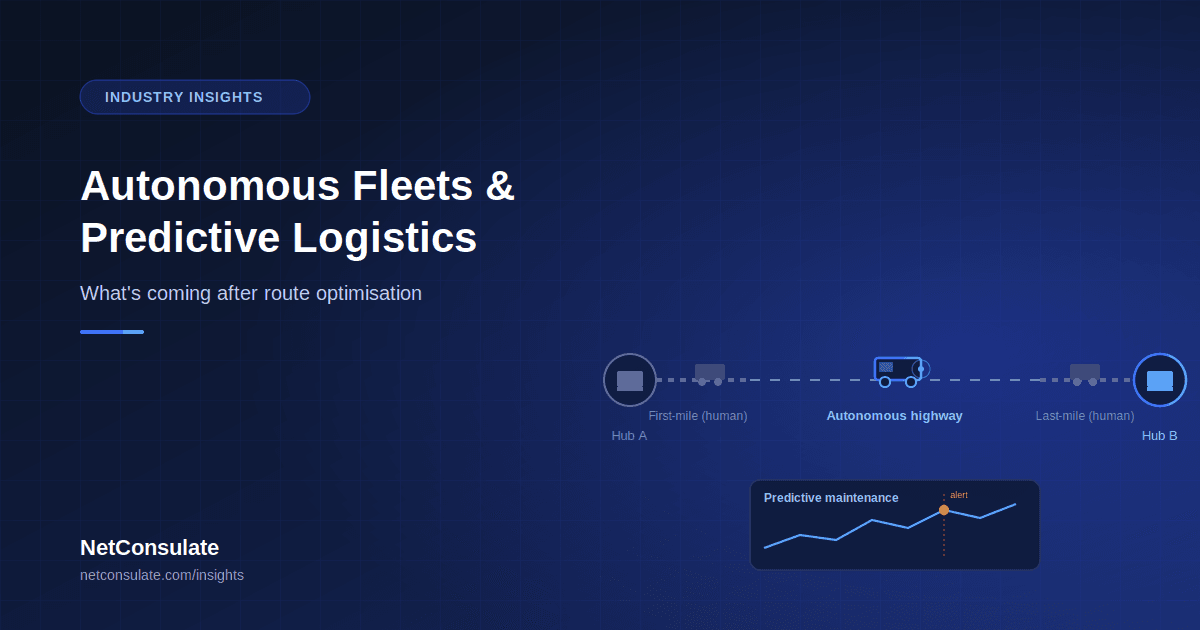
The caveat that matters for realistic planning: this remains a hub-to-hub model, not door-to-door. Autonomous trucks handle the long-haul highway segment between logistics transfer points — the predictable environment where autonomy delivers the most value — while human drivers continue managing first-mile pickup, last-mile delivery, complex urban navigation, loading docks, and customer interaction. This division of labour is deliberate, not a limitation to apologise for: it puts autonomy exactly where highway driving is most predictable and keeps humans exactly where judgment, dexterity, and interpersonal contact remain essential.
Aurora is now extending beyond pure hub-to-hub with direct customer-endpoint deliveries in 2026 — autonomous trucks navigating to specific shipper and receiver facilities rather than only transfer hubs — a meaningful expansion of the addressable use case, aided by mapping techniques that can add a new route after a single manual drive rather than extensive manual survey.
The realistic scale for now: Aurora is targeting 200-plus trucks by the end of 2026, with capacity fully booked through Q3 — and the broader autonomous long-haul market, valued at $2.7 billion in 2024, is projected to grow at roughly 32% annually toward $42.6 billion by 2034. That's a genuinely fast-growing category, but the absolute truck count remains small relative to the overall freight fleet — this is early-stage commercial deployment, not fleet-wide replacement, and treating it as anything more than that leads to poorly timed strategic bets.Where Else Autonomy Is Already Working — Ports, Not Just Highways
Highway trucking gets the headlines, but a genuinely under-discussed deployment is already running at commercial scale in a more controlled environment: container ports. Ports are among the most autonomy-friendly environments that exist — predictable roads, consistent cargo, no pedestrians, 24/7 operating schedules — and multiple ports across the US and Asia now run autonomous yard trucks moving containers between ships and staging areas around the clock, without the complexity highway driving introduces.
Urban middle-mile delivery is the next frontier being tested in controlled conditions: geofenced autonomous freight pilots in cities including Phoenix, San Antonio, and Dallas are extending autonomy into defined urban delivery zones — a deliberately narrower, more controlled version of the door-to-door problem highway trucking hasn't solved yet.
The pattern across every genuinely working deployment is consistent: autonomy succeeds first in the most predictable, most controlled version of a problem, then expands outward as the technology and mapping mature — exactly the same principle that governs hub-to-hub trucking, and worth remembering when evaluating any vendor's autonomy roadmap.
Predictive Maintenance — Already Delivering Documented, Auditable ROI
While autonomous driving captures attention, predictive maintenance is the AI logistics capability with the most mature, best-documented return on investment today — and it requires no autonomous vehicles at all to deliver value.
The technique works by establishing baseline operating parameters for each specific vehicle in its typical operating environment, then flagging deviations before they become roadside failures. One documented case illustrates the mechanism concretely: a 400-vehicle refrigerated fleet's AI system flagged three trucks showing simultaneous coolant temperature spikes and voltage drops — a pattern indicating imminent water pump failure that traditional diagnostics would have missed entirely until the trucks broke down on the road. This is the same anomaly-detection logic covered in our predictive maintenance guide, applied specifically to a rolling, distributed fleet rather than fixed factory equipment.
The ROI conversation here has genuinely moved from theoretical to documented and auditable across fleet sizes, industries, and geographies — CFOs increasingly treat this as a proven operational investment with predictable returns, not an experimental technology spend. Combined with fuel optimisation, route efficiency, computer-vision-based collision prevention, and administrative automation, fleets report compounding returns across multiple categories simultaneously rather than a single isolated saving.
Critically, this capability has also become genuinely accessible to fleets of any size — modern platforms offer AI-powered maintenance and predictive analytics starting at a few dollars per vehicle per month with no long-term contract, meaning predictive maintenance is no longer a large-fleet-only capability, unlike autonomous trucking, which remains concentrated among large carriers and freight networks for the foreseeable future.
Augmented Driving — The Real 2026 Story, Not Replacement
For years the trucking industry was told drivers would be largely obsolete by 2026. That has not happened, and the honest 2026 assessment is that the professional driver remains the backbone of the supply chain, with autonomous trucking active but still limited to defined middle-mile corridors. The genuine success story of 2026 is augmented driving rather than replacement: computer-vision-based systems that predict and help prevent collisions before they happen, materially lowering insurance premiums and improving safety outcomes for human-driven fleets right now, independent of when or whether full autonomy reaches their operation.
This matters strategically: augmented driving delivers real value today, to fleets of every size, without requiring any bet on autonomous vehicle timelines — making it the more accessible near-term investment for most operators, with predictive maintenance and augmented driving together forming what's increasingly framed as the practical foundation every fleet needs before advanced autonomy becomes relevant to them.
What Comes After Route Optimisation — The Trajectory
Putting the pieces together, the direction of travel for logistics AI over the next several years follows a reasonably consistent pattern industry analysts converge on:
Fully integrated logistics networks, not isolated point solutions. The next stage is autonomous trucks, smart warehouses, and predictive inventory systems operating as a single continuous system rather than separate tools bolted together — where a demand signal, a warehouse pick, and a freight movement are planned and adjusted together in real time rather than sequentially handed off between disconnected systems. Freight contracts priced on delivery consistency, not just capacity. As autonomous and augmented systems make delivery timing genuinely more predictable, freight pricing is shifting to reward operators who can guarantee consistency — a metric largely unavailable to purely human-driven operations at scale, and a genuine competitive differentiator for early movers. The competitive battleground shifts from asset count to data infrastructure quality. A recurring theme across current industry analysis: the operators building strong data infrastructure now — clean telematics, historical maintenance records, route performance data — are positioning themselves as the incumbents of the next decade, while those without that foundation risk becoming acquisition targets rather than competitors, regardless of current fleet size. Autonomous capacity will mostly be accessed, not owned. For the great majority of fleets, autonomous trucking capability will arrive through freight network partnerships rather than fleets purchasing and operating autonomous vehicles themselves — meaning the practical near-term question for most operators is not "should we buy autonomous trucks" but "is our data and operations infrastructure ready to plug into an autonomous freight network when it makes sense to."What Logistics Operators Should Actually Do Now
Build the data foundation regardless of your autonomy timeline. Historical maintenance records, route performance data, driver behaviour metrics, and clean vehicle telematics are the prerequisite for everything described above — predictive maintenance today, and any future integration with autonomous freight networks or augmented driving systems. This is the single highest-leverage investment available to fleets of any size right now. Adopt predictive maintenance and augmented driving now — the ROI case is already proven. Neither requires betting on autonomy timelines, both are accessible to fleets of any size, and both deliver documented, auditable returns today rather than a promise about the future. Treat autonomous capacity as a network relationship, not a purchase decision, for the foreseeable future. Watching freight network and hub-to-hub partnership developments in your specific corridors is a more productive near-term strategy than evaluating whether to purchase autonomous vehicles directly. Match technology maturity to environment predictability when evaluating any pilot. The pattern holds everywhere it's worked — ports before urban streets, hub-to-hub before door-to-door, geofenced pilots before open deployment. Any vendor proposing to skip that sequence deserves particular scrutiny.A Readiness Checklist
- Telematics and maintenance data infrastructure assessed for completeness and quality
- Predictive maintenance evaluated against documented ROI case studies for fleets of comparable size
- Augmented driving / collision-prevention systems assessed against current insurance and safety costs
- Freight corridors mapped against current and announced hub-to-hub autonomous network coverage
- Internal data strategy reviewed against the "data infrastructure as competitive moat" trajectory
- Realistic distinction maintained internally between deployed capability (predictive maintenance, augmented driving, hub-to-hub highway autonomy) and still-maturing capability (door-to-door autonomy, fully integrated logistics networks)
Conclusion
The genuinely new part of the autonomous fleets story in 2026 is not that self-driving trucks exist — it's that they're hauling real freight on real highways in defined, commercially booked routes, following a hub-to-hub model deliberately scoped to where autonomy works best today. Alongside it, predictive maintenance and augmented driving have quietly become the more universally accessible, better-documented investments — delivering compounding, auditable returns to fleets of any size without requiring a bet on when full autonomy arrives. The operators positioning well for what comes next are building clean data infrastructure now, treating it as the actual foundation the next decade of logistics AI will run on.
If your organisation is building predictive maintenance, fleet data infrastructure, or preparing for integration with autonomous freight networks, NetConsulate designs the data pipelines and predictive systems that turn fleet telematics into measurable operational return — today, regardless of your autonomy timeline.
Building predictive maintenance or fleet data infrastructure for your logistics operation? Submit a proposal request and our team will respond with a tailored approach within 2 business days.