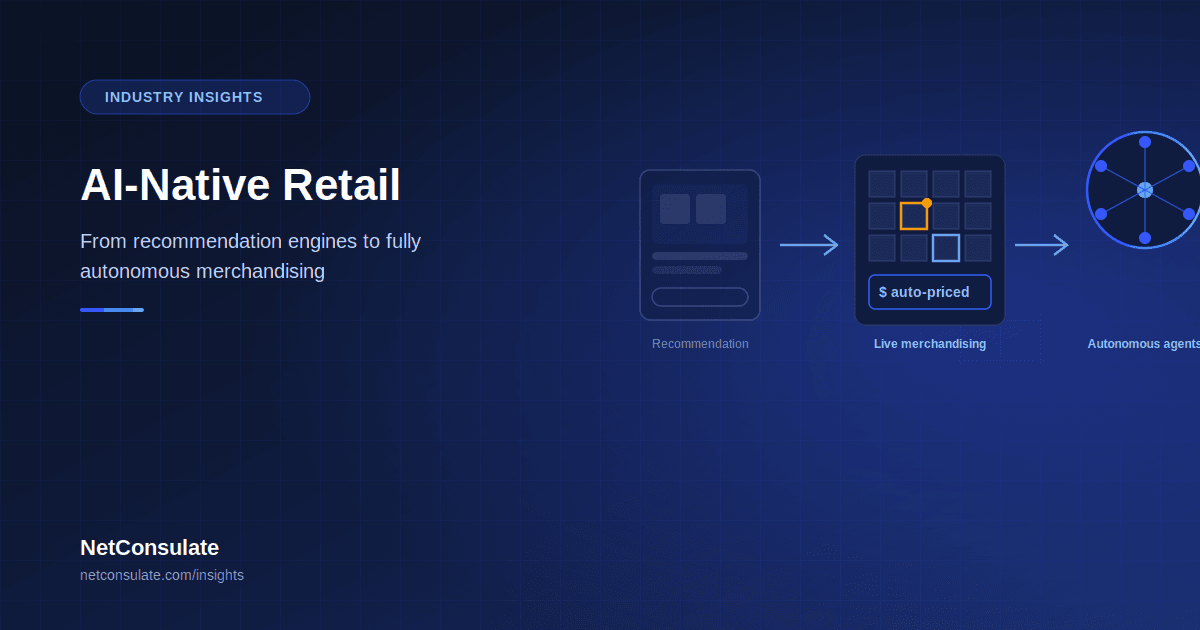
AI-Native Retail: From Recommendation Engines to Fully Autonomous Merchandising
The recommendation engine was retail AI's opening move — suggest a product, personalise a homepage, nudge a cart. It's now table stakes, present on nearly every commerce site built in the last decade. What's happening in 2026 is a different order of change: AI agents that don't just suggest what a shopper might want, but autonomously decide pricing, reroute inventory between stores, negotiate with suppliers, and increasingly complete the purchase itself — reasoning, planning, and executing retail decisions with limited human involvement in the loop.
This article explains the shift from recommendation to autonomous merchandising, what's genuinely running in production today versus still emerging, the zero-click commerce trend already reshaping how retailers must think about discovery, and what a retail organisation should actually build toward. It follows directly from our guide on agentic commerce and connects to our broader work on autonomous AI agent architecture — this is that architecture applied specifically to retail decision-making. Written for retail technology leaders, e-commerce teams, and merchandising decision-makers.
The Autonomy Spectrum — Why "Agentic" Isn't All-or-Nothing
The useful distinction for understanding this space: traditional retail AI recommends, while agentic AI decides and acts. A recommendation engine analyses and suggests; an agentic system reasons about a live signal, decides on a response, and executes it — running a retail decision from signal to action largely on its own, inside defined guardrails.
Autonomy itself runs on a spectrum, not a binary switch. Retailers now automate pricing, replenishment, allocation, and markdowns with agents operating at different degrees of independence depending on the stakes involved — an allocation agent moving inventory between stores to match local demand may run with minimal oversight, while a pricing agent making margin-affecting decisions typically operates with defined boundaries and human review at the edges. Understanding this spectrum matters more than debating whether a system is "truly agentic" — the practical question for any retailer is which decisions warrant which level of autonomy, not whether to go fully autonomous everywhere at once.
What's Already Running in Production
Autonomous merchandising and pricing. Agentic workflows now manage pricing, inventory, and promotions with enough independence that merchandising has become a genuinely real-time, adaptive system rather than a periodic planning cycle — a structural break from the batch-driven, monthly or seasonal analytics cycles that defined retail decision-making for decades. Specific agent roles are emerging with distinct responsibilities: an assortment agent assessing productivity per square foot and identifying assortment gaps; an inventory agent monitoring shipments and on-shelf availability, proactively flagging and resolving potential stockouts before they affect sales. Always-on market intelligence. Where periodic analytics once left a persistent lag between a market shift and a retailer's response, agentic systems now continuously sense and interpret live signals — competitive pricing moves, inventory anomalies, shifting customer sentiment — collapsing the gap between a trend appearing and a retailer acting on it from weeks to near-real-time. Named large-scale deployments. This is not confined to startups or pilots: Walmart is deploying AI-powered shopping tools, Target has rolled out conversational AI capabilities, and Amazon continues expanding AI assistant capabilities for autonomous product discovery — three of the largest retailers in the world treating this as core infrastructure, not experimentation. Supply chain coordination. Autonomous agents are being used to coordinate directly with suppliers, predict disruptions before they cascade, and automatically reroute orders for resilience — extending agentic decision-making upstream from the shelf to the supply chain itself, an area where the stakes of a wrong autonomous decision are high enough that governance design matters as much as the underlying model.Zero-Click Commerce — The Discovery Layer Is Already Changing
Perhaps the most disruptive near-term shift for retailers is not merchandising automation but where product discovery happens at all. Companies like Google and OpenAI are increasingly intermediating discovery — reshaping how shoppers find and evaluate products, often outside a retailer's own storefront entirely. The scale of this shift is no longer theoretical: search engine traffic to brand-specific sites is projected to fall by roughly 25% by 2026, driven by consumers increasingly using generative AI channels like ChatGPT for product discovery instead of a traditional search-then-click journey.
This connects directly to the protocol landscape covered in our agentic commerce guide — UCP, ACP, and the payment-network integrations now letting agents complete purchases directly. The practical implication for retailers: your product needs to be discoverable and transactable by an AI agent your customer is using, not only by a human browsing your website. A retailer whose product data, pricing, and availability aren't cleanly exposed to these discovery layers risks losing visibility entirely in a growing share of purchase journeys — becoming, as one analysis put it, a background utility in an agent-controlled marketplace rather than the destination itself.
What Building Agent-Ready Retail Infrastructure Actually Requires
Four architectural principles recur across credible guidance on preparing retail systems for this shift, and they apply whether you're building for internal merchandising agents, external shopping agents, or both:
Expose clean APIs for AI systems to consume. Product, pricing, and transaction capabilities need to be accessible through well-structured APIs so both internal agents and external platforms can reliably discover, evaluate, and transact against your systems — the same discipline covered in our AppFunctions guide, applied to commerce rather than mobile apps specifically. Enable real-time inventory, pricing, and promotion data. Operational data must be continuously updated and accessible, not refreshed on a batch schedule — an agent making an autonomous pricing or allocation decision based on stale inventory data will make confidently wrong decisions at machine speed, which is a materially worse failure mode than a human making the same mistake slowly. Decouple frontend experiences from backend logic. Separating customer-facing interfaces from core commerce functionality means new channels — a shopping agent, a messaging platform, a marketplace integration — can be launched without rebuilding the underlying systems each time a new surface emerges, which matters given how quickly the discovery landscape itself is shifting. Support rapid experimentation across channels. Teams need the ability to quickly test, launch, and iterate new merchandising approaches and pricing strategies across different touchpoints — agentic retail moves faster than the quarterly planning cycles most merchandising organisations were built around, and the underlying systems need to support that pace.Governance — Where Autonomous Merchandising Gets Genuinely Risky
Autonomous pricing, allocation, and promotion decisions running with limited human oversight raise real governance questions that responsible retailers are building for from the start, not retrofitting after an incident:
Traceability and auditability. Every autonomous agent action needs to be traceable — which agent made which pricing or inventory decision, based on what signal, and why — both for internal accountability and because retail pricing and promotional practices sit inside consumer protection law in most jurisdictions. Brand and compliance guardrails. Configurable guardrails ensuring every AI action stays on-brand, legally compliant, and secure — particularly around customer PII and payment data — are table stakes for any credible platform in this space, not an optional add-on layer. Human oversight calibrated to stakes, not applied uniformly. Following the guardrail discipline from our agent architecture guide directly: low-stakes, high-volume decisions (routine replenishment) can run with minimal oversight, while margin-affecting or customer-facing pricing decisions warrant defined approval boundaries — autonomy should scale with consequence, not be maximised everywhere by default. Emerging standards are still sparse but arriving. Global frameworks like ISO/IEC 42001 for AI management systems are beginning to be referenced in retail contexts, though practical, retail-specific adoption remains limited as of 2026 — meaning most governance discipline in this space today comes from internal design choices rather than external compliance mandates, which makes getting the internal discipline right now more important, not less.A Practical Path Forward
Phase 1 — Foundation. Clean, real-time product and inventory data exposed through structured APIs — the prerequisite for everything that follows, and where most agentic retail initiatives should actually start regardless of ambition level. Phase 2 — Pilot deployment. Start with low-risk, high-impact use cases — inventory optimisation is the recurring recommended starting point — and deploy single-agent solutions before attempting coordinated multi-agent systems, proving governance and measurable value on a bounded problem first. Phase 3 — Scale and orchestration. Implement multi-agent systems for more complex workflows and extend agentic commerce capabilities across customer touchpoints once the foundation and governance model are proven — the same "start narrow, prove value, expand" pattern that has held across every AI deployment discipline covered on this site, from predictive maintenance to defect detection.The market sizing underlying this urgency is substantial by any measure: agentic AI is projected to represent 10-15% of retail IT spending in 2026, growing toward roughly 26% of budgets by 2029, with the broader agentic commerce market estimated to reach $3-5 trillion globally by 2030 — a scale that makes this a strategic infrastructure decision for retailers now, not a future consideration to revisit later.
A Readiness Checklist
- Product, pricing, and inventory data accessible through structured, real-time APIs
- Frontend experiences decoupled from backend commerce logic
- A specific low-risk, high-impact pilot use case identified (inventory optimisation is the common starting point)
- Governance model defined with autonomy calibrated to decision stakes, not applied uniformly
- Traceability and audit logging designed into agent actions from day one
- Discoverability assessed for AI-driven discovery channels (ChatGPT, AI Mode, agentic shopping assistants), not only traditional search
- A realistic view of where your organisation sits on the autonomy spectrum today versus where the next 12–18 months should take it
Conclusion
The shift from recommendation engines to autonomous merchandising is not a distant prediction — it is running today at Walmart, Target, and Amazon scale, reshaping how pricing, inventory, and promotions get decided, while simultaneously changing where product discovery happens at all as zero-click, agent-mediated commerce grows. The retailers positioning well are treating this as infrastructure work — clean APIs, real-time data, decoupled systems, and governance calibrated to actual decision stakes — rather than a single AI feature to bolt onto an existing storefront.
If your organisation is building agent-ready retail infrastructure — from merchandising automation to discoverability for AI shopping agents — NetConsulate designs the data architecture, agent systems, and governance that turn autonomous retail from a strategic aspiration into a working, accountable system.
Building agent-ready retail or merchandising automation? Submit a proposal request and our team will respond with a tailored approach within 2 business days.