AI for Disaster and Conflict Response Logistics: Getting Aid Where It's Needed Fastest
The same problem defines every disaster and every humanitarian crisis, whether triggered by earthquake, flood, or conflict: critical supplies need to reach damaged, contested, or communication-dark areas fast, and the traditional planning tools — fixed routes, manual dispatch, best-guess prioritisation — were never built for conditions changing by the hour. Roads get blocked. Communication lines fail. Needs shift faster than a paper plan can be redrawn. AI is now a working part of how leading humanitarian operations close that gap — not replacing the responders on the ground, but giving them a faster, clearer picture of where to go and what to bring.
This article explains how AI is actually being used across the humanitarian logistics lifecycle, what's genuinely deployed and validated versus still research, and what organisations building or supporting this capability should understand. Written for humanitarian technology leads, government disaster-response agencies, and NGOs and logistics partners operating in disaster and conflict-affected regions. The framing throughout is deliberately about protecting and reaching people, not about the conflicts or disasters themselves.
The Core Problem AI Is Solving
Humanitarian logistics has always had to answer four questions under severe uncertainty: what will be needed, where, how much, and how do we get it there when the usual infrastructure doesn't work. AI-enabled decision support systems extend traditional emergency-management tools by enabling real-time analytics and pattern recognition across genuinely heterogeneous data sources — satellite imagery, social media signals, IoT sensor networks, weather models, and ground reports — feeding four core functions: demand forecasting, facility location and prepositioning, transportation routing, and last-mile delivery under uncertainty.
The shift this represents is significant: forecasting and data-driven planning have moved from a slow, largely manual process to something closer to continuous, adaptive replanning as conditions change — bridging the gap between an early warning and effective boots-on-the-ground action in a way static planning never could.
Where This Is Already Working
Demand forecasting that prioritises before shipment. Machine learning models predict where people will need food, water, and medical aid most urgently, letting response teams prioritise shipments and avoid the delays that come from guessing — pulling in satellite data, weather models, and ground reports to forecast where resources will matter most before a single truck moves. Finding people who need help, at scale. Natural language processing tools scan social media posts and emergency calls to identify people requesting help — information that would take a human team far longer to surface manually, especially across large-scale events generating thousands of simultaneous reports. Real seismic and wildfire response, documented. Following the 2023 Türkiye-Syria earthquake, AI-powered seismic analysis tools helped predict aftershocks, allowing rescue teams to plan operations more safely. During the Los Angeles wildfires, AI-driven predictive modelling played a direct role in assessing fire trajectories, optimising evacuation routes, and ensuring medical teams were deployed effectively — concrete, documented instances of this technology reducing response time in events that mattered. Dynamic routing around damaged infrastructure. When teams tie AI into supply chain and logistics systems, they can optimise delivery routes using live data on road closures, fuel availability, and vehicle capacity — replanning routes as conditions shift rather than working from a route plan drawn before the disaster hit and never revisited. Cross-region coordination without language as a bottleneck. Some platforms now offer multilingual translation integrated directly into coordination tools, easing communication across responding agencies and countries in large-scale events where miscommunication between international teams can measurably slow the response.The Last-Mile Problem — Where the Hardest Engineering Lives
Getting aid to a regional hub is the comparatively easy part. The genuinely hard problem — and where the most rigorous research has concentrated — is the last mile: moving supplies from a working staging point into communities where roads are damaged, demand is uncertain, and communication infrastructure may be down entirely.
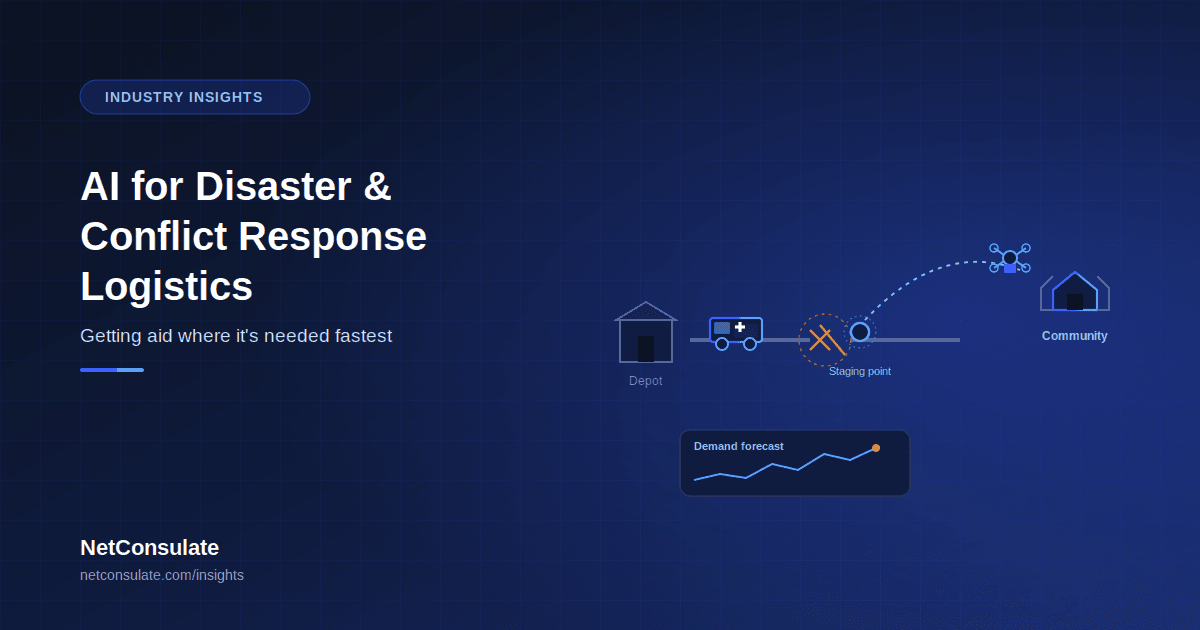
The most credible technical approach validated for this problem is a two-echelon architecture combining trucks and drones:
This architecture exists specifically because it matches the real constraint pattern of disaster response: trucks can carry far more volume than drones but need passable roads; drones can reach communities cut off by damaged infrastructure but carry limited payload and have constrained range. Combining them lets responders use the right tool for each leg rather than being blocked entirely when the direct road route is unusable.
Researchers have validated this approach against real-world-scale data — including a widely cited framework tested against a dataset simulating emergency aid demand across Puerto Rico following Hurricane Maria, explicitly built to handle the uncertainty in what communities need when communication infrastructure prevents them from simply reporting it directly. The models optimise for the two metrics that matter most in practice: the proportion of demand that goes unfulfilled, and the average delay before aid reaches a community that needs it — not abstract efficiency metrics, but the numbers that map directly to real outcomes for real people waiting for supplies.
A related concept worth watching as the technology matures further: the "humanitarian flying warehouse" — a high-altitude airship functioning as a mothership for delivery drones, proposed specifically to traverse geographical barriers that ground-based logistics cannot cross at all, potentially extending the two-echelon model into terrain where even trucks can't establish forward staging points.
The Honest Gaps — What Research Says Still Needs Work
A comprehensive review of the field is candid about where the discipline remains underdeveloped, and this candour is worth taking seriously before over-promising what current systems can do:
Research concentrates heavily on early-phase response; recovery and long-term resilience remain underexplored. Most AI attention goes to the acute emergency phase — the first hours and days — while the recovery, mitigation, and long-term supply chain resilience phases of a crisis receive comparatively little research attention, despite being where sustained humanitarian need often continues longest. Data fragmentation is a persistent, unresolved obstacle. Humanitarian data sources are frequently fragmented and incomplete across agencies, regions, and event types — and no amount of modelling sophistication compensates for a system built on data that doesn't actually connect. Explainability remains limited. In a domain where decisions directly determine who receives aid and who waits, the limited explainability of many AI-driven models is a genuine practical and ethical constraint, not an academic footnote — a responder or oversight body needs to understand why a system prioritised one community's needs over another's. Siloed system design blocks coordination. Humanitarian logistics inherently involves multiple agencies and organisations working the same crisis simultaneously — and systems built without interoperability in mind actively work against the coordination a crisis response requires. Fairness and equity in resource distribution are unresolved, serious concerns. An optimisation model that minimises average delay or maximises overall coverage can still produce distribution patterns that are systematically less fair to specific communities — smaller populations, harder-to-reach areas, or groups underrepresented in the data the model was trained or calibrated on. This deserves the same rigour as the impact-assessment discipline covered in our AI for human rights guide, applied specifically to who receives aid and how quickly.What Organisations Building This Capability Should Actually Prioritise
Treat data integration as the foundation, not an afterthought. The research consensus is unambiguous: fragmented, siloed data is one of the most persistent obstacles in this field. Interoperability between agencies' systems delivers more real-world value than a marginally more sophisticated routing algorithm running on incomplete data. Build explainability in from the start, not as a compliance layer added later. Decisions about aid prioritisation carry real consequences for real communities — the same principle from our AI governance work applies directly: impact assessment and explainability belong in the design phase, not bolted on after a system is already making prioritisation calls. Design for the full disaster lifecycle, not just the acute emergency phase. Given how concentrated current research and tooling is on early-phase response, organisations that also build for recovery and longer-term resilience planning are addressing a genuinely underserved part of the problem — and likely facing less competition for that capability. Plan for degraded and contested conditions specifically, not just "disaster" in the abstract. Conflict-affected logistics carries additional constraints beyond natural disaster response — damaged infrastructure that may be actively deteriorating rather than static, communication blackouts that are sometimes deliberate rather than incidental, and security considerations for responder safety that a wildfire response doesn't carry. Systems built only against natural-disaster assumptions may not transfer cleanly to conflict settings without this considered explicitly. Build the two-echelon routing pattern where road infrastructure is uncertain. The truck-plus-drone architecture is validated, practical, and directly applicable to both natural disaster and conflict-affected logistics — a strong starting architecture rather than something to design from scratch.A Readiness Checklist
- Data sources mapped across all responding agencies, with interoperability gaps identified explicitly
- Demand forecasting approach chosen with clear handling of uncertainty, not just point estimates
- Last-mile routing architecture designed around actual road and communication conditions in the target region
- Explainability requirements defined before deployment — who needs to understand and audit prioritisation decisions
- Fairness and equity in distribution assessed explicitly, not assumed from aggregate efficiency metrics
- Coverage planned across the full disaster lifecycle, including recovery and resilience phases
- Conflict-specific constraints (security, deliberate infrastructure damage, communication blackouts) addressed separately from natural-disaster assumptions where relevant
Conclusion
AI is already a genuine, documented part of how the most capable humanitarian and disaster-response operations work today — from the seismic analysis that helped rescue teams operate more safely after the Türkiye-Syria earthquake, to the two-echelon truck-and-drone routing validated against real Hurricane Maria data, to the demand forecasting that lets responders move with prioritised precision instead of guesswork. The technology doesn't replace the people delivering aid on the ground; it gives them a faster, clearer picture of where to go and what to bring, under conditions that would otherwise force decisions on incomplete information.
What the research is equally clear about is where the work remains unfinished — data fragmentation, limited explainability, and unresolved fairness questions in who receives aid and how quickly. Organisations building this capability responsibly treat those gaps as core engineering and governance requirements, not footnotes.
If your organisation is building or strengthening AI-driven disaster or humanitarian logistics capability, NetConsulate designs the data integration, predictive routing, and governance infrastructure that gets aid to the people who need it fastest — with the explainability and fairness discipline this work demands.
Building AI-driven disaster response or humanitarian logistics capability? Submit a proposal request and our team will respond with a tailored approach within 2 business days.